Municipal Cultural Center (Former Post Office Building)
The building is a neocolonial architectural work inaugurated in 1949, built to house the former headquarters of the Post and Telegraph Office. In 1981 it was declared a National Monument. In the precinct operate different schools of art where the formation in visual arts, dance and music is promoted. The cultural project is promoted by the Municipality of Guatemala and is aimed at audiences of all ages.

Horario
Monday: 9 - 17 h
Tuesday to Friday: 9 - 18 h
Sábado: 9 – 16 h
Hours
Monday: 9 – 17 h
Tuesday to friday: 9 – 18 h
Saturday: 9 – 16 h
The building is a neo-colonial architectural work inaugurated in 1949, built to house the former headquarters of the Post and Telegraph Directorate. In 1981 it was declared a National Monument. The campus is home to various art schools that promote education in visual arts, dance, and music. The cultural project, driven by the Municipality of Guatemala, is aimed at audiences of all ages.
About the artists at the venue
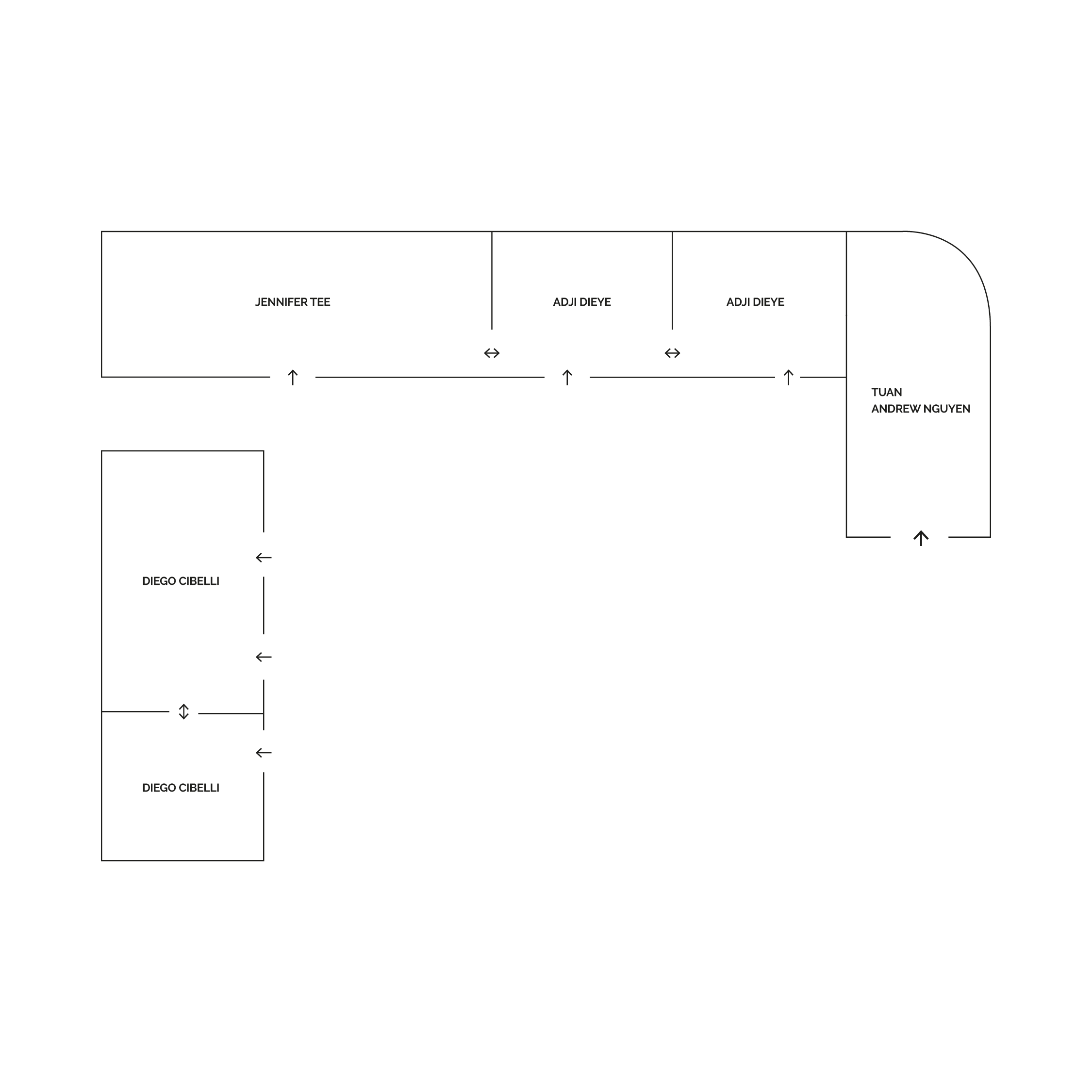
At the Post Office Building, ‘The World Tree’ serves as a powerful exploration of identity, memory and cultural heritage, with artists reinterpreting this universal symbol to confront the interplay of diverse times, identities and narratives, while also addressing social concerns and the search for social justice.
The work of Tuan Andrew Nguyen re-imagines ‘The World Tree’ as the axis mundi, a timeless concept that connects multiple planes of existence, from the Mayan cosmovision to Western philosophies.
Inspired by Mayan and African traditions, Adji Dieye reinterprets sacred geometries, exploring how color can function as an active archive, embodying the persistence of memory across geographies and histories.
The environmental installation of Diego Cibelli intensifies the interaction between mythology and temporalities, weaving diverse narratives, performative rituals of passage and baroque extravagance.
Jennifer Tee, The project explores identity and cross-cultural narratives through Sumatran Tampan textiles and personal memories of family migration, confronting the potential loss of language, identity and cultural ties.
Together, these artists approach ‘The World Tree’ to generate a narrative that transcends cultural, temporal and personal boundaries, allowing for a dialogue that connects displaced communities, ancestral cosmologies, aspirations and contemporary struggles.
About the artists at this venue
At Correos, ‘The World Tree’ serves as a powerful exploration of identity, memory, and cultural heritage, with artists reinterpreting this universal symbol to confront the interplay of diverse times, identities, and narratives, while also addressing social concerns and the pursuit of social justice.
Tuan Andrew Nguyen‘s work reimagines ‘The World Tree’ as the axis mundi, a timeless concept that bridges multiple realms of existence, from Mayan cosmovision to Western philosophies.
Inspired by Mayan and African traditions, Adji Dieye reinterprets sacred geometries, exploring how color can serve as an active archive, embodying the persistence of memory across geographies and histories.
Diego Cibelli‘s environmental installation intensifies the interplay of mythology and temporalities, weaving diverse narratives, performative rites of passage, and Baroque extravagance.
Jenifer Tee explores cross-cultural identity and narratives through Sumatran Tampan textiles and personal family migration memories, confronting the potential loss of language, identity, and cultural ties.
Together, they tackle ‘The World Tree’ to generate a narrative that transcends cultural, temporal, and personal boundaries, enabling a dialogue that connects displaced communities, ancient cosmologies, and contemporary struggles and aspirations.
Mapa de la sede